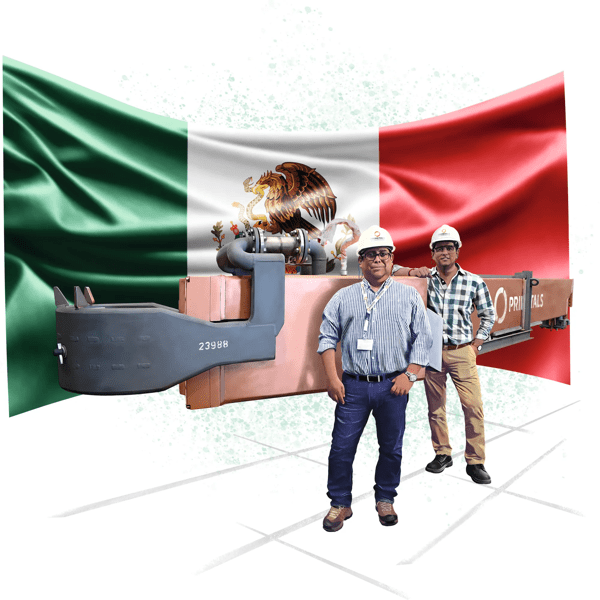
Primetals Technologies Mexico is located in Apodaca, which belongs to the metropolitan area of Monterrey, the country’s third-largest city. The company's location specializes in the manufacture of core components for electric arc and ladle furnaces, and performs a variety of maintenance operations for steel producers via its growing services business. Metals Magazine’s Dr. Tom Widter visits the location and discovers what makes the place, the people, the culture, and the Mexican morning sky so unique.
I step outside Monterrey airport and am immediately greeted by the hot Mexican air. It’s 8:30 pm on what must have been a testing, sun-scorched August day. Even after dusk, the temperature stays well within the “excessive” range. The 39 degrees Celsius of a few hours earlier has dropped only slightly to 34 degrees, and it takes just minutes for my clothes to feel as if they are glued to my skin. I have flown into Monterrey via Atlanta airport, which was an experience in itself, with stores selling Donald Trump-branded chocolate and sleeping pills that you’d never be able to buy without a prescription in Europe. Contrary to Atlanta, there is no chocolate at Monterrey airport adorned with the face of López Obrador, the Mexican president—yet.
Upon arrival, my first impression is that Monterrey has the aura of a U.S. province with a Mexican twist; about half of the voices I hear are American. There’s, of course, a reason for the American influence. The city has grown considerably over the last few decades, both in terms of population and productivity, thanks to an influx of international enterprises wanting to be close to the U.S. market and profit from Mexico’s lower labor costs. Many of the companies that define Monterrey today belong to the cement, glass, and automotive sectors—and of course to the steel industry. Steel producer Ternium alone has four production sites in various parts of the city and intends to keep growing. In Monterrey, you can feel the economy humming.
Welcome to Apodaca
The Mexican company location of Primetals Technologies is based in Apodaca, which belongs to the greater Monterrey area. My taxi ride to the location is rather interesting weather-wise: it is close to sunrise, and the sky is filled with something gray that is neither fog nor clouds. While I can make out brighter and darker parts—an indicator of the time of day—all of the sky’s blue is still in hiding. I check the weather app on my smartphone; evidently, the condition is called “smoke,” and is characteristic of the region. Then, just as I arrive at the company location, the color on the horizon changes to that of liquid steel. So where there’s smoke, there is fire, after all.
I am immediately welcomed by Rocio Pelayo, the CEO’s personal assistant. Like many of her compatriots, Pelayo effortlessly embodies many of the wonderful, typically Mexican qualities: great warmth, openness, hospitality, joyfulness, and—as I will discover—enormous depth and complexity. Pelayo shows me around the site. It comprises two workshops and an office building, which itself consists of two sections and was custom-designed to reflect the Primetals Technologies brand. The section housing the main entrance is round, almost circular, and painted orange; viewed from above, it looks like the Primetals Technologies company logo, which consists of two half-circles. And since the airport is relatively close, air travelers with a window seat can catch a glimpse of the company logo on their approach.
I then met Guillermo Gonzalez, former CEO of Primetals Technologies Mexico, and Karsten Kliewe, the head of finance. Prior to his assignment to the Monterrey location, Kliewe worked in Germany, Brazil, the U.S.A, and China. I ask him what, in his opinion, stands out about the Apodaca workforce. “We have a great team spirit here,” he says. “Everyone is totally dedicated to implementing the long-term strategy we’ve developed. Sometimes, we’ll find the need to recalibrate certain aspects of this strategy, and it’s immensely gratifying to see just how open and ready the staff is to making the required adjustments. They always work in unison.”
Touring the Workshops
Integral to achieving the location’s goals are the two on-site workshops. They are 3,000 and 2,500 square meters in size, and there are plans for two more workshops, as the location keeps growing. Blas Zapata, the head of operations, takes me on a tour. “Our two current workshops are independent of one another but essentially capable of manufacturing the same products,” he says. This setup enables Zapata to dynamically allocate resources, depending on what orders and maintenance contracts the location is fulfilling at the time.
One of the location’s specialties is the production of core components for electric arc and ladle furnaces. At the time of my visit, both workshops were very busy manufacturing electrode arms and fingers for the EAF Quantum, the electric steelmaking solution from Primetals Technologies, capable of preheating the input material, scrap, before loading. This feature enables the furnace to achieve significant energy savings compared to more traditional models. Zapata shows me electric arc furnace components at various stages of assembly in Workshop One.
The electrode arms are welded from thick, dual-layer plates, which are cut on a special machine that resembles a large barbecue grill—but with a water tank underneath where you’d expect the coal fire. The plates are then welded together so that the steel layer ends up on the inside and the copper layer on the outside of the electrode arms. Since the arms have to withstand great heat, they employ a complex water-cooling architecture. “We rigorously test all water-cooling equipment we make,” Zapata says, “which is why we have testing stations in both of our workshops. We send pressurized water into the arms for an hour to make sure there is no leakage.”
The Apodaca workshops manufacture various core components for electric arc and ladle furnaces. The picture shows the electrode arms used in the EAF Quantum.
This is one part of a cooling solution that will be mounted on the roof of an electric arc furnace. It will be combined with more components to cover all 360 degrees.
The company location invested in three new machines to be able to manufacture what is called "elbows." These are welded to the ends of two adjacent pipes.
From these parts, the workshop staff will be creating the "fingers" for the Quantum electric arc furnace. The fingers hold and release the scrap during preheating.
The Fingers of Giants
So what are the fingers for, I ask Zapata. “These are essential to the EAF Quantum’s functionality—in that they hold and release the scrap in the preheating shaft,” he says. Depending on the respective furnace configuration, the workshop staff will produce either 14 or 16 fingers per set. Each finger is massive, but just like the electrode arms, they remarkably begin their life at the plate cutter. Zapata tells me that the cutter could handle plates of even greater thicknesses. “Up to eight inches,” he says. “Plasma cutters can do that.” I find it quite impressive, and almost a little scary, to think that this machine can go through steel plates as if they were slices of toast.
Zapata and I continue to make our way through Workshop One. We walk by several other products made at the workshop: a modular panel for installation inside the electric arc furnace, as well as side panels and various other kinds of cooling equipment, from small to large to enormous. “This one goes on top of the furnace,” Zapata says, pointing to a particularly large device that has the shape of a large slice of pie. I wonder how the cooling would work with this part, given its strange shape. “Of course, you’d have to combine several of these elements to cover the entire furnace top, in 360 degrees,” Zapata explains. Now that he says it, it seems obvious.
One thing Zapata is particularly proud of is the location’s ability to manufacture elbows for its cooling equipment in-house. So what are elbows, and what do they do? A lot of the cooling solutions made at the workshop consist of copper or carbon-steel pipes, through which water will be pumped after installation. But while these pipes can be bent—in fact, the workshop has several different machines that do this—, they couldn’t be bent into a 180-degree angle. This is where the elbows come in. They connect one pipe to the adjacent one and ensure effective water flow through the complete cooling device. “We previously had to source elbows from third-party manufacturers. Now that we make them ourselves, we’ve been able to
offer our customers even better prices.”
Servicing Caster Rolls
Workshop Two focuses not only on the production of electric arc and ladle furnace components but also on the servicing of operational parts. Primetals Technologies Mexico has recently received a contract from steel producer Ternium for the offline maintenance of its continuous thin-slab caster, and Zapata guides me through the entire process of roll cleaning and reconditioning. This procedure is only one of the maintenance tasks Ternium has decided to outsource to Primetals Technologies, and involves complex welding, because a 9-millimeter thick metal layer has to be added onto the rolls.
First, every roll is warmed up using a gas burner to avoid the build-up of pores during the welding process, which could lead to cracks. Even at this stage, the roll is continually rotated for homogenous heat distribution. Then, while the roll keeps rotating, the welder makes two passes, each of which takes two hours and incrementally thickens the roll. The welder adds the additional layer in a fine line, so that after welding, the roll surface resembles the growth rings of a tree. Clearly, no roll could be used this way for production, which is why it is finally taken to the machining section of the workshop, where it loses the “tree rings” and receives a polished, professional, “good as new” look.
Metallurgical services like this one will become more and more central to the location’s activities. Zapata and CEO Gonzalez both expect substantial growth in the services area, as they are targeting not only the Mexican market but also Canada, the USA, and Central and South America. They strive to be the partner of choice to steel producers wanting to outsource maintenance work in order to further improve productivity and keep unscheduled plant downtime to a minimum. In terms of metallurgical services, Gonzalez believes that his team is only at the beginning—and having witnessed the incredible craftsmanship in the Apodaca workshops, I’m convinced he will be proven right.
Making a Difference
After the workshop tour, I sit down with various members of the company location’s team to learn more about their passions, their ambitions, and their culture. During our discussions, I find myself quite taken by the way they express themselves: Everyone uses well-chosen phrases to describe their thoughts and feelings, on top of which there is a beautiful shift in melody that the Spanish accent imparts on the English language. You can sense the large country, its rich history, the relative poverty of certain regions, the love of life, the strong commitment to family and friends, and the determination to make a difference in this world.
One of the topics I bring up in my conversations is that of common misconceptions about Mexico. What surprises foreigners most when they first visit the country and meet its people? “I sometimes feel there is a widespread belief that Mexicans will not make an effort—the assumption that they’ll do a sloppy job compared to Americans,” says Mayra Gonzalez, a logistics manager, knowing the opposite to be true. “Also, we don’t always wear Sombreros or ride donkeys to work,” she adds. Which is also true—as I’d be happy to testify.
Luis, the location’s sales director, points out that “so many parts of Mexico are actually much safer than people think,” addressing foreigners’ concerns about a lack of security in the country. “Our tap water is also much more drinkable than people assume,” he adds. I ask Luis what role he’d like Mexico to play in ten years’ time—on the world stage and in the hearts of its people. “I would want Mexico to make even greater advancements in terms of manufacturing,” he says, “for instance, in the car, aerospace, and chemical industries, as well as in other areas with high-value-added products.” He believes that the services sector has equally great potential and concludes by telling me that he wants the people of Mexico to be known “for their entrepreneurial spirit and engineering competence.”
A Fiery Spectacle
Accompanied by Rocio, I conclude my stay in Monterrey with a visit to the city’s “Museo del Acero,” its steel museum, which goes by the name of “Horno3.” It’s a recommendation of Guillermo Gonzalez, who rightfully considers it a “must see” for anyone setting foot in the Monterrey metropolitan area. “The museum is effectively a converted steel plant, the oldest in all of Mexico, and has an 1880 Bessemer furnace and a 1970 blast furnace,” he tells me, as if I needed further persuasion.
Driving to the museum, Rocio tells me a bit more about the place. The original steel works, “la fundidora,” was built from 1890 to 1900—a time of political and social stability, general industrialization, and the construction of the country’s railway network. Steel products such as beams, rods, and structural parts for bridges were in high demand, but had to be imported. The fundidora was going to change this—and it did, until May of 1986, when it closed its doors. On August 16, 2007, these doors were reopened, and the plant rose from the ashes as arguably the world’s most innovative steel museum.
Horno3 is full of interactive devices that make it easy to learn more about minerals, mining, ironmaking, steelmaking, alloying, rolling, and strip processing. I get to play musical notes on a xylophone made of drill cores, try my hand at being a furnace operator (I do surprisingly well), and watch a wrestling match where every wrestler represents an element in the steelmaking process—such as oxygen, sulfur, and “winners” iron and carbon. Rocio and I then take the rail trackway to the top of the furnace and watch the “furnace spectacle” that entails an LED-lit furnace replica, flashing to the rhythm of traditional Mexican music. Again, magnificent poetry meets masterful execution. The animated spectacle includes drill noise, smoke, and the molten pig iron’s fiery glow. What better way to end my trip than with Horno3?
The plane takes off, and as I look outside the window, I see the company location come into view, with its characteristically round, orange-colored building. In my thoughts, I wave goodbye to the people, the warmth, the deep solidarity, the strong work ethic, and the poetic depth with which I’ve found my Mexican colleagues to express themselves. “Comparado con el alma mexicano, el cielo es limitado,” I think as the aircraft disappears into the sky. There is something so profound and special about the Mexican spirit, and yet it is so elusive when you try to capture or define it. Maybe it just can’t be tamed—like you can’t tame fire. Or liquid steel. I eventually stop trying—and wonder what my friends would say if I bought a bar of Trump chocolate in Atlanta as a souvenir. A bottle of Tequila or a sombrero might be the safer choice.
is circular—and it is also painted orange. Viewed from above, its form resembles the shape of the company logo of Primetals Technologies, which consists of two orange-colored semicircles.
It can get quite hot in Apodaca, much more so than in southern regions of the country. As can be seen in this photo, the staff of Primetals Technologies Mexico are always on the lookout for places that will provide shelter from the hot summer sun.
Driving is pretty safe in Monterrey, even during rush hour. Most cars are well-maintained, and you can use Google Maps to get realtime traffic data updates and pick the best route. The motorbike to the left, however, might not be the city's safest vehicle ...
Working out whose birthday it was proved to be an exercise in futility. According to those familiar with the matter (i.e., the employees photographed), the decoration was put up many months ago. No one wanted to take it down, so it remained there.
The Cerro de la Silla is a mountain with no less than four peaks, Pico Norte (North Peak) being the highest at 1820 meters above sea level. The mountain is popular with hikers, who take the 3-hour long trail to the top to catch the panoramic view of the city.